
MAMA COCA'S EARLY DANCE
WITH WESTERN CIVILIZATION
From Conquest to Coca-Cola™
Derived from Gods and Disease, by Fernando Cabieses, 1974.
NOTE: The elision marks (…) were in the original text.
Any text I elided for lack of relevancy or clarity is noted as [text omitted] -- Patt
For many centuries, at least as far back as 1000 B.C., the inhabitants of the highlands of the Andean region have consumed the leaves of coca (Erythroxylon coca). [text omitted]
The habit of consuming coca leaves is still extremely common among the present-day dwellers of Peru, Ecuador and Bolivia, and, according to all available information, the technique for using the leaves has not changed much throughout the centuries. An average of six to eight million kilograms of coca leaves are consumed every year in Peru where the common habitual chewer takes a daily amount varying from 10 to 100 grams. The average adult consumer chews approximately 30 grams daily, but there are exceptional chewers who will take as much as 200 to 300 grams every day.
Although one speaks usually of “coca chewing,” the act of consumption may not properly be called chewing, at least in its complete process (the native term for this is chacchar). The consumer takes a handful of coca leaves and carefully cleans it from dirt, debris and the main nerves of the leaf. He puts the clean leaves in his mouth and chews on them for three or four minutes until the bolus is well formed. Then he takes the bolus out of his mouth and pricks it deeply and repeatedly with a pointed stick which carries an alkaline substance to be described below. The bolus is therefore put back in the mouth and kept there, under the cheek, without chewing, for about one or two hours during which the “chewer” sucks on it while he goes about his business. Finally the bolus, called acullicu [compare, kurak akulliq], is either discarded or swallowed.
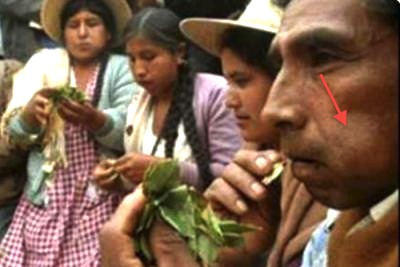
The man on the far right has an akulli of coca in his left cheek.
Usually this process is repeated with about 10 grams of leaves every three to four hours, with an interruption of current activities for about thirty minutes in order to prepare the bolus in what might be called a “coca break.” It is exceptional to find “chain chewing,” which brings up daily consumption to about 300 grams per person.
The reasons for adding an alkaline substance to the bolus are really not known. The composition of this material varies somewhat from region to region, ranging from plain quick lime to ground seashells or ashes of different plants. This substance is known by the general term of llipht'a. In exceptional cases no substance is added, but there is archeological evidence to show that, in one way or another, it has been used for as long as coca has been known to man. Scientists are inclined to think that this substance increases the yield of alkaloids, but there is conflicting evidence in this regard, others stating that the alkaline powder just enhances the taste …
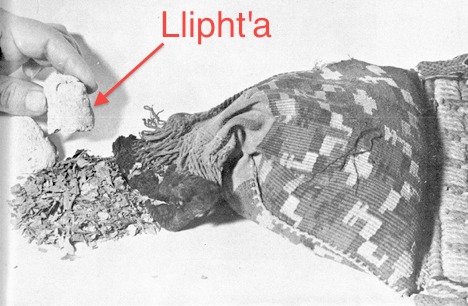
A pouch of coca of the Tiwanako-Huari culture, and a piece of llipht'a. DYEDYE · Source not listed on the original Text Sources page.
Coca has been revered to the point of deification from time immemorial in Peru. It formed part of a multitude of religious ceremonies, funeral rites and magic tricks in practically all of the pre-Columbian cultures of Peru. Its effect upon the human organism abolishing fatigue, pain and hunger was always considered supernatural, and its cult became of such importance that one of the Coyas, the wife of the fourth Inca (Mayta Ccapac), adopted the sacred name of Mama Coca, and a sister of the Inca Huayna Ccapac, who later was appointed abbess of the Aclla Wasi of Cusco, also used this name.
Not much is known about the use or abuse of coca leaves during the pre-Inca period. One of the most frequent findings in the graves of this prolonged epoch is that of small purses full of the sacred leaves which were presented to the deceased before departing on his last journey. It was a rather generalized funeral custom, common to all social and economic classes; but from this we cannot deduce with any degree of certainty how popular or how extended was the consumption of the leaves among the living members of the community. In fact, the same funeral custom was common in the Inca period; but from all available sources we have a clear knowledge that the consumption of coca leaves during life was a very exclusive privilege of the Imperial elite, being forbidden to the common citizen.
When the Spanish conquerors arrived, the prestige of the coca plant was probably at its climax.* It constituted an indispensable part of the armamentarium in all religious and funeral festivities. It was sought after and used by all magicians, diviners and healers in their ceremonies, sortileges and tricks. It was cultivated in special, carefully tended and cherished farms and, most important of all, human consumption during life was reserved most exclusively for the Inca and his family.
In the social chaos which followed the Conquest, the coca plant became the center of agitated argument. Despised by the Spaniards as an unsightly and stomach-turning habit, the starving, tired Indian masses suddenly had this royal delicacy at their easy reach. The destitute Indian toiler, denied of fatherland, human dignity, family, religion, culture and tradition, found in this food of the gods a remedy for his hunger, for his fatigue, for his debasement. And his greedy Spanish master discovered in the coca leaves an easy-to-get and inexpensive substitute for wages and food. Coca chewing became generalized.
But things did not stop there. Soon the Catholic priests and missionaries began to realize that “idolatry” and native religion could hardly be wiped out from among their new brethren if this magic plant, the mysterious shrub put in this world by the devil himself, was to continue exerting its satanical influence. It certainly had an infernal effect upon the Indians which could not be explained by any earthly powers. No wonder it was used practically in every one of their sortileges and sacrifices and demoniac rites!
This argument, however, did not really convince more than a few religious men. It never influenced the behavior of masters or laborers, and only went to expand the long list of bonafide recommendations which both the Church and the distant Spanish King made to the avid settlers. Deaf ears.
The same may be said about the decrees of Viceroy Toledo forbidding the cultivation of the coca plant. These ordinances, we must emphasize, were not based on any notion of damage produced by the human consumption of the leaves, nor were they inspired by any religious or cultural interpretations. The coveted shrub grows only on the hot, humid eastern slopes of the Andes where labor force was scarce or totally absent. Therefore, large crowds of Indians were brought down from the cold, clean and dry air of the sierras into these humid, steaming gorges and ravines fraught with disease. [See, climatology.]
[text omitted] [I]t is to the credit of Viceroy Toledo who, basing his decrees on the Spanish experience of a few years and the notions accumulated during centuries by the ancient Peruvians, ordered the cultivation of coca in these areas to be stopped.
It goes without saying, however, that in spite of these decrees, the devilish plant continued to be cultivated and death continued to ravage the flourishing plantations. Defying all the above, the coca plant maintained its very high prestige in Peru throughout all the Colonial Period.
Not much was heard about it in Europe at this time. Being cursed with a rather unfavorable reputation of satanic origin which connected it so intimately with heresy and idolatry, one is not surprised that its native fame at the time of the Inquisition never found a sufficiently curious or adventurous mind which could help the coca plant reach the European shores except through the carefully scrutinized and censored chronicles. [Footnote deleted.]
The earliest scientific consideration on coca was its botanic classification carried out by Plukenet. But more than forty years elapsed until 1735 when Joseph de Jussieu [text omitted] arrived in Peru. In 1749 this tenacious investigator of the Peruvian flora sent to his brother Antoine in Paris a large series of samples of coca which formed the basis for the first deep study of this plant.
It was on his herbarium that Browne, several years later (1 756), based his studies and created the genus Erythroxylon, a name derived from the red color of the wood of certain species (E. aerolatum). The coca plant was included in his genus and this was soon confirmed by Linnaeus., another Jussieu** (Antoine Lawrence, nephew of the others), presented an ample study of the taxological intricacies of the coca plant, and his ideas were in the end confirmed by the earnest pen of Jan Baptist Lamarck in 1782.
By this time, interest for Peru began to grow again in Europe. Besides the reports of the local scientists, the rediscovery of Peru [text omitted] could not fail to account for this plant with such a deep human value. Hipolito Unanue (the local medical leader of the time), published in 1791 learned considerations on the anti-fatigue action of coca and its usefulness to the campaigning armies. In this turn, Humboldt (in 1801) and many other erudite travelers of the epoch called attention to the interesting properties of this plant. The enthusiasm of the scientific world kept growing when the young Peruvian republic opened its doors to all the scientists from abroad.
Tschudi, the young Swiss naturalist who visited Peru shortly after the Independence, repeatedly emphasized the usefulness of coca leaves to combat hunger and fatigue, as well as its apparent innocuity. Tschudi himself took it frequently and reported that it enhanced his own resistance to high altitudes. Dr. Weddell, a notorious French botanist who came to peru with a scientific expedition sponsored by Louis Philippe of Orleans in 1849, reaffirmed the opinions of Tschudi and this was also the case with Gibbon and Herndon, two North American scientists who visited Peru in 1854.
The interest of the scientific world really developed, however, after the publications of Paolo Mantegazza, an Italian physician who practiced medicine in Peru and who, in 1859, published in Milan a juicy monograph on the excellences of the exotic Peruvian plant, not only as a stimulant but also as food and as a remedy for several ailments. A firm panegyrist of the coca plant, Mantegazza said in one of his enthusiastic writings: “… I would rather live ten years with coca than one million years without it ….” He lived exactly ten more years, and nobody really responded to his pleas.
In the same year that the verbose Italian amazed the world with his exuberant pronouncements, Sir Clement Markham, who had come to Peru following his interest in the cinchona bark, became so fascinated by many other aspects of Peru that he could not fail to pay some attention to the coca plant. With his well recognized scientific judgment, and in contrast with the picturesque discourse of Mantegazza, Markham concluded that the coca leaves fight fatigue and hunger and avoid “the respiratory difficulties which appear when one ascends very high mountains” “This latter quality,” he said, “should make it recommendable to the Members of the Alpine Club and travelers in general … “
All this interest in the amazing properties of the sacred plant of the Incas coincided with the development of chemistry. The current discovery of the alkaloids and other active substances of many remedies and poisons found in nature occupied the minds of the scientists of the time and it was only natural that the friends of the coca plant pressed upon the laboratories to find the intrinsic cause of the pharmacological action of this substance.. [text deleted]
There followed a series of research projects in many other laboratories, but those failed. [text omitted] Yet in the famous Prussian University, Professor Woehler (who previous to being a chemist had been a physician and surgeon), had become infected with Tschudi's zeal to uncover the mystery of coca. Knowing that his friend Doctor Scherzer would come to South America with an Austrian scientific expedition, he asked him to collect enough coca as to start an exhaustive research which was put in the hands of his disciple Alberto Nieman. This latter worked during the decade 1850-1860 and discovered cocaine.
In the meantime and during the following years, several universities in Europe continued their interest in the coca leaves as an anti-fatigue substance. This is not strange since, in spite of the scientific objectivity of the great investigators, it must have been difficult to avoid the attraction of this herb which came from El Dorado and which seemed to concentrate the strength, infatigability and youth which legend gave to those distant regions of the world. Thus, in 1876, Sir Robert Christison from Edinburgh, published a lengthy study of coca, declaring that it was the most potent and effective anti-fatigue substance found in nature. This assertion has never been refuted. In those years, one could freely buy it in Paris (and it was quite popular among sportsmen and olympic athletes) a preparation of coca leaves called “Velo-coca,” a single dose of which, it was assured, would take away the fatigue produced by a 30 miles bicycle run ...
The discovery of cocaine by Albert Nieman, however, very soon carried everybody to the conclusion that the action of coca was totally explained by the effects of this alkaloid and, since then, all the physiological experiments were conducted with cocaine. The coca plant, as such, never again entered the physiological laboratories of Europe. [emphasis mine - Patt]
Another quarter-century elapsed before the anesthetic action of cocaine was discovered. A man known to us because of his superhuman work in psychology, Dr. Sigmund Freud, made this discovery.
In August, 1884, Freud and other psychiatrist, Dr. Joseph Brener, were treating a great physiologist (whose name is kept in reserve) of a serious case of morphine addiction. Freud had been experimenting with cocaine as being contrary to morphine when he noticed that the Peruvian alkaloid had a clear anaesthetic action upon the tongue. He made a note of it and passed the information to his friend, Dr. Koenigstein, an ophthalmologist, suggesting, according to his own autobiography, “that he should investigate the question of how far the anaesthetizing properties of cocaine were applicable in diseases of the eye.” At that time, Freud was courting the young lady he would later marry and, after making the above suggestion, he promptly left his laboratory to visit her in a distant city.
When he returned to Vienna, he found that Koenigstein had dropped the matter. However, another of his ophthalmologist friends, Dr. Karl Koeller, to whom he had also spoken about cocaine, had made the decisive experiments upon animals' eyes and had made himself famous as the discoverer of local anaesthesia with cocaine.
We have been unable to find proof that the ancient Peruvians had any practical knowledge of the anaesthetic properties of coca. They could not have missed the benumbing effects it has upon the tongue and inner lining of the mouth. Nobody who has chewed the leaves for a few minutes -- and this can be done in Peru at any moment, any place, just going over to the corner grocery store and buying it -- can fail to notice the progressive deadening of sensitivity of tongue, gums and cheeks which soon follows. But this observation, like many other too obvious clues in the history of human knowledge, may have passed unnoticed in its potential value for centuries and centuries, until Dr. Freud took the hint.
Even with a clearly scientific culture as that of XIX Century Europe, this continued to be so. As we have seen, the alkaloid had been isolated by Nieman in 1860, and Professor Woehler, commenting on the findings of his disciple, emphasized that cocaine had “a very peculiar effect on the nerves of the tongue.” It made it insensible and anesthetized it. He had detected it but, in spite of his knowledge of medicine and surgery, he failed to see the practical application of this observation. (We should remember that Woehler was not a common scientist: he was the discoverer of metallic aluminium and of beryllium, he carried out the synthesis of urea and of uric acid, he isolated boron and silicon, synthetized the quinonas and his chemical studies revolutionized the current knowledge of organic chemistry).
Two years later, Schroff carried out in Germany a series of experiments with cocaine. He remarked also on the anaesthetic action it had on the tongue, a fact which was similarly emphasized by Demarle, who was working independently in France. In 1865, a famous clinician in Paris, M. Fauvel, prescribed gargles of an infusion of coca leaves to alleviate sore throat. This was soon approved and adopted by Morrell Mackenzie in England and by Louis Elsberg in U.S.A. None of them, however, chose to go farther to discover the uses of cocaine as a local anaesthetic.
In 1879, a very famous German surgeon of Russian origin, came even closer. V. Anrep reported that the area of the skin injected with cocaine turned totally insensible to painful stimuli. He went far as to suggest that this substance might perhaps be used as a local anaesthetic . . . . But notwithstanding that he had a thousand opportunities in his very active surgical practice, he did not continue his studies and never used it on his patients. None of his pupils and followers paid any attention to Anrep's suggestions until Freud and Koeller came up with the experiments. How many Woehlers and Anreps are hidden in the dark caves of Andean pre-history?
One cannot deny that coca leaves or concoctions made with them may have been applied by the ancient Peruvians as plasters on open wounds or burns in order to alleviate pain. Or that coca infusions or other preparations may have been ingested to calm stomach pain or put in the mouth to deaden toothache***. All this is possible. But there is not much evidence to prove or disprove such occurrences.
The use of coca in practically all sortileges or magic passes which accompanied each and every healing act makes our search even more difficult. Not infrequently the old writings tell about painful processes which were alleviated with the aid of coca leaves, yet none is clear enough to permit us to establish the role -- anaesthetic or magic -- which the leaves played. Indeed, as we will see below, there are writings which specifically mention the pharmacological alleviation of pain through the use of herbs, concoctions or alcoholic beverages. But in these specific instances there is never one word about coca.
We cannot say, therefore, that local anaesthesia was “invented” by the ancient Peruvians. Even if they did, their discovery never reached the Western mind. But taking into consideration that Erythroxylon coca is the only naturally occurring local anaesthetic, it is only fair to thank that old Peruvian herbalist who, many centuries ago, called the attention of his world to this remarkable plant. Without his contribution, the history of anaesthesia and of surgery certainly would have been different.
By the year 1880, the coca plant seemed to have found an independent course which avoided the ill fame which was being built around cocaine. . . .
A most picturesque individual, Doctor Angelo Mariana, born in Corsica, installed in Neuilly, in the suburbs of Paris, what can be considered as the Temple of Coca, the mysterious plant of ancient Peru. In the gardens and greenhouses of Mariani's installations, the sacred plant of the Incas was honored as once dreamed of by the old Tarpuntaes in Cusco.The cult of the coca plant took root in Paris as it never could have been imagined by the ancient Peruvian sorcerers, and Mariani's Institute began to accumulate works of art and scientific reports dealing with such a marvelous plant. M. Roty, President of The Academy of Fine Arts of Paris, rendered a special homage to coca and awarded it a very artistic gold medal of his own personal design. Musicians like Gounod, Faure, Massanet and others, enthusiastic patrons of Mariani's place, sang in sweet original melodies the great qualities of the Peruvian plant; even Pope Leo XIII sent Mariani a gold medal with the most enthusiastic ecclesiastical approval of the use of coca. According to the news of that time, the Pope found a very useful aid to his ascetic way of life in a small bottle he always carried containing a preparation of coca leaves which Mariani sent him regularly. . . [More on this below] [text omitted]
Yet, in spite of this enormous enthusiasm for the coca plant during the later part of the XIX Century, cocaine soon monopolized the attention of the scientific world.
The mischievous cocaine -- the first daughter of the devilish plant -- was very soon denounced throughout the world as an impudent and dangerous wench who, no matter how useful, enslaved the wills and whims of all who had to do with her. And although she was promptly replaced by less effective but less dangerous synthetic step daughters, she has continued to spread throughout the world the hidden curse of an old Peruvian witch.
While Mariani was surrounded by luxury and honors in Paris, a man of about 50 years of age, who for 15 years had lived in Atlanta, Georgia, had an intuition as to what the “wine of Mariani” could become. John Styth Pemberton, a pharmacist who always hunted for new formulas, registered in U.S.A. by the year of 1885 the “French Coca Wine, an Ideal Tonic and Stimulant.”
Soon, with the initial impulse that this “discovery” gave to his business, he founded the Pemberton Chemical Company which next year began to market a new product which would revolutionize the world. In fact, it was a total modification of the “French Wine”: in order to register it as a non-alcoholic beverage, the wine was discarded; to make it more stimulating, he added some caffeine; and since the resulting preparation tasted awful, a mixture of aromatic oils and essences was thrown in. Finally, as the recent adventures of Livingstone and Stanley in Africa had attracted the attention of the world to another stimulant grown in Africa, namely, the cola nut (Cola acuminata), Pemberton added this new component to the mixture and registered the whole concoction under the trade mark of Coca-Cola™.

At the beginning, this new beverage was sold in drugstores as a syrup to be diluted in water and taken as tonic, stimulant and as a good remedy for “the morning after.” But soon somebody began to add carbonated water….
In 1891, a gentleman named Asa G. Candler, now an almost legendary figure, arrived in Atlanta. He had with him exactly one dollar and seventy-five cents. That was all his fortune.
He moved around, pulled strings, pushed wheels, talked to people and a few months later he bought from Pemberton the formula of the new beverage. One year later, Candler founded the Coca Cola Company™ and, fifteen years later, his assets were estimated at fifty million dollars.
Candler patented the way to bottle carbonated beverages and made Coca Cola™ an international necessity.
By the turn of the century, Coca Cola™ began to change its image. It was no longer a tonic or a remedy for alcoholic excesses. It was a refreshment… A pause that refreshes™… Keeping its name and its composition based on coca leaves, it soon solved the potential conflicts with the Pure Food and Drug Act of 1906 and all traces of alkaloids coming from the coca plant were eliminated. It will kept the caffeine, the cola nut and all the other components of the coca leaves in what is officially named “a non-narcotic extract of decocainized coca leaves.”
We know the rest: carefully sterilized, decocainized, sweetened, carbonated and God-knows-what-else, the coca plant, displaying the Peruvian colors (red and white) throughout the world, has traveled the seven seas and conquered every corner reached by Western civilization.
* The first European who mentions it in his writings is Americo Vespucio, who found it during his exploration of the Caribbean.
** The Jussieu family gave us several botanists of great renown…
*** Father Cobo writes in the XVI Century that chewing coca alleviates toothache.
Reprinted here without permission because I simply cannot find the copyright owner. Please contact me if you have any information so that I may obtain permission from the current copyright holder. The author (Dr. Cabieses) is deceased; however, he has a family somewhere in Peru to which I wish to speak about having this marvellous book reprinted.
Vin Mariani
All text and pictures below taken from Wikipedia:
Vin Mariani (French: Mariani's wine) was a tonic and patent medicine created circa1863 by Angelo Mariani, a French chemist who became intrigued with coca and its economic potential. In 1863, Mariani started marketing a wine called Vin Tonique Mariani (à la Coca du Pérou) which was made from Bordeaux wine treated with coca leaves.
The ethanol in the wine acted as a solvent and extracted the cocaine from the coca leaves, altering the drink's effect. It originally contained 6 mg of cocaine per fluid ounce of wine, but Vin Mariani which was to be exported contained 7.2 mg per ounce in order to compete with the higher cocaine content of similar drinks in the United States. Advertisements for Vin Mariani claimed that it would restore health, strength, energy, and vitality.
Vin Mariani was very popular in its day, even among royalty such as Queen Victoria of Great Britain and Ireland. Pope Leo XIII and later Pope Saint Pius X were both Vin Mariani drinkers. Pope Leo awarded a Vatican gold medal to the wine, and also appeared on a poster endorsing it.
Thomas Edison also endorsed the wine, claiming it helped him stay awake for longer hours. Ulysses S. Grant was also a fan of the wine, which he began drinking while writing his memoirs towards the end of his life.
This tonic evidently inspired John S. Pemberton's 1885 coca wine drink recipe called Pemberton's French Wine Coca. Later that year, when Atlanta and Fulton County passed prohibition legislation, Pemberton responded by developing a carbonated, non-alcoholic version of his French Wine Coca. The beverage was named Coca-Cola because the stimulants mixed in the beverage were coca leaves from South America and kola nuts, the beverage's source of caffeine.

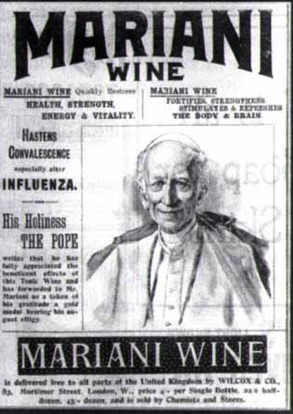
The poster reads:
MARIANI WINE
MARIANI WINE: quickly Restores HEALTH, STRENGTH, ENERGY & VITALITY.
MARIANI WINE: FORTIFIES, STRENGTHENS, STIMULATES & REFRESHES THE BODY & BRAIN.
Hastens Convalescence, especially after Influenza.
His Holiness THE POPE writes that he has fully appreciated the beneficient effects of this Tonic Wine and has forwarded to Mr. Mariani as a token of his gratitude a gold medal bearing his august effigy.
MARIANI WINE: To be delivered free to all parts of the United Kingdom by WILLCOX & CO. [address], and be sold by Chemists and Stores.
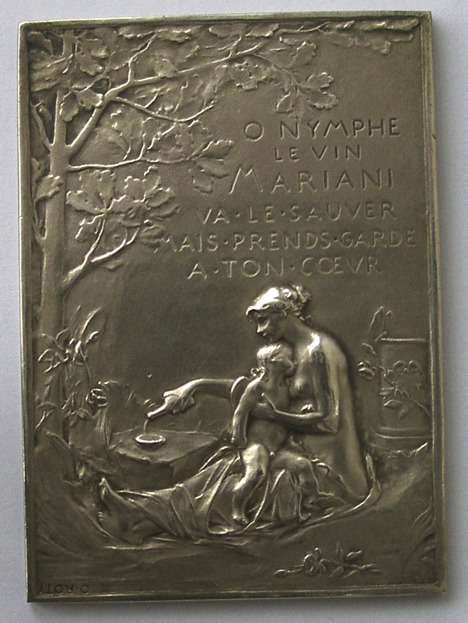
Vin Mariani medal by Louis-Oscar Roty. WIKIWIKI · en.wikipedia.org (no www)
According to a Reuters article dated March 11, 2013, Evo Morales, Bolivia's president and in-your-face cocalero, went before the United Nations Commission on Narcotic Drugs and told them that the coca plant would be a crop that would be a part of his country's drive to industrialize its economy. He discussed the history of cocaine and Vin Mariani, and added, "I really hope the new Pope, who should be named soon, will also use the wine like Mariani." Vin Mariani was prized for its benefits and was used by public figures such as Queen Victoria and Thomas Edison.
In January 2013, Bolivia was re-admitted to the UN anti-narcotics convention after it convinced the members to "recognize the right of its indigenous people to chew the leaf." -- Patt