k'aja onqoy
(n) Fever. PSLPSL · www.geocities.com/phillott/Bolivia/Dictionary02.htm — Bolivian Quechua
27 entries
(n) Fever. PSLPSL · www.geocities.com/phillott/Bolivia/Dictionary02.htm — Bolivian Quechua
(n) Splendor. RSRS · runasimi.de
(n) (a) Light energy analogous to celestial energy or electromagnetism in physics. It is the highest form of spiritual energy used by the curanderos of Peru. It is effective because it accesses the timeless realms of spirit, allowing the person in need of healing to step out of time and experience a sense of infinity. The healer experiences k’anchay energy as a subtle, laser-like pulsation or very rapid vibration. K’anchay helps maintain the necessary balance between the influx of spirit and the grounding energies of the Earth, which are necessary to sustain a natural equilibrium between one’s physical and luminous bodies; (b) Clarity, clearness; (c) Light; glory. PSPMPSPM · Peruvian Shamanism: The Pachakúti Mesa, Magee (v) To give light. PSLPSL · www.geocities.com/phillott/Bolivia/Dictionary02.htm — Bolivian Quechua To shine. RSRS · runasimi.de
(v) To arouse interest. RSRS · runasimi.de
(v) To brighten; to light. RSRS · runasimi.de
(n) Torch; flare. RSRS · runasimi.de
See, runa kurku k’anchay.
(v) To sting, to hurt (pain like alcohol on a wound). PSLPSL · www.geocities.com/phillott/Bolivia/Dictionary02.htm — Bolivian Quechua
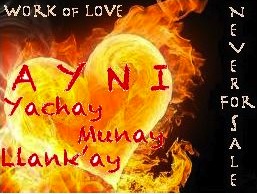
(n) A little fan of three cocoa leaves representing the three worlds brought together in prayer for offerings; a bouquet. Used to exchange energies with others. RSRS · runasimi.de KOAKKOAK · Keepers of the Ancient Knowledge, Wilcox In curanderismo, the k’intu represents (a) the three worlds: hanaqpacha, kaypacha and ukhupacha; (b) the three attributes humans have come into this world to bring into balance: llank’ay, yachay and munay; and the three fields of the curandero mesa: campo ganadera, campo justiciero, and campo medio. The k’intu is a symbol of the integration of body, mind, and heart working in ayni within the center. Often offered to the sacred mountains (apukuna) and various sacred sites (huacas) and places of energetic import. PSPMPSPM · Peruvian Shamanism: The Pachakúti Mesa, Magee Quality, not quantity, of the offering is important. Leaves are carefully sorted to select the most perfectly shaped and the largest. ACAIACAI · The Andean Codex, J.E. Williams Three coca leaves joined together as an offering; the three leaves represent the three worlds or realms (kaypacha, hanaqpacha, and ukhupacha), the three divine attributes of human equilibrium (llank’ay, munay, and yachay), and the three primary curative energies (kawsay, sami, and k’anchay) ANON1ANON1 · anonymous donor 1 (see footnote on the original Text Sources page for explanation)
(v) To injure or wound. QPQP · Quechua Phrasebook, Coronel-Molina
(adj) Wild, untamed. PSLPSL · www.geocities.com/phillott/Bolivia/Dictionary02.htm — Bolivian Quechua
See, Koa.
(v) To kneel, to bow. PSLPSL · www.geocities.com/phillott/Bolivia/Dictionary02.htm — Bolivian Quechua
(n) Rainbow. CHAMCHAM · Chamalu, Luis Espinoza RORROR · Rituals of Respect, Bolin The pachatira called Mach’acuay (serpent) is said to dominate the night sky during the rainy season; thus, during the rainy season, these multicolored serpents are visible during the day and the black one at night. Rainbow serpents are said to have two heads, emerging from a spring, arcing across the sky, and returning in to the earth or into another spring. After a rainbow stretches across the sky, it does not always remain and can move willfully along the earth for many reasons, most of them malevolent: in order to steal from men or to enter the abdomen of women through the vagina causing severe pain. Rainbows that arise from subterranean waters cause intense pains of the stomach and head, vomiting and sickness in general. Both sexes are prohibited from urinating in the presence of a rainbow because that can cause it to move and enter the person via the urine, causing severe stomach pain. They are the manifestation, in reptilian form, of the forces of procreation and fecundity which lie within the earth. ACESACES · At the Crossroads of Earth and Sky, Urton The mountain people think rainbows are dangerously evil. One story told is that when people see a rainbow they must keep their mouths closed or a spirit-cat [Koa] will run down the rainbow and jump into their mouth and kill them. Another story is that rainbows are ways for lake serpents to travel to visit other serpents in other lakes. Again it is very dangerous for a person nearby because the snakes may bite them, unless they keep very, very quiet. [Internet source lost.] Leaving this place [Tambo Toco] they [Manco Capac and Mama Ocllo] came to a hill at a distance of two leagues, a little more or less, from Cuzco. Ascending the hill they saw a rainbow, which the natives call huanacauri. Holding it to be a fortunate sign, Manco Ccapac said: “Take this for a sign that the world will not be destroyed by water [See, Uñu Pachacuti].” HOIHOI · History of the Incas, Sarmiento de Gamboa They fear the rainbow that pursues and violates the young girls; especially do they avoid waterfalls, because there a rainbow is always found. TAVTAV · The Awakening Valley, Collier and Buitrón Some Amazon tribes have similar beliefs and proscriptions. One explains that the rainbow takes the energy from water up to the clouds and to bathe in such water is to suffer a deadly loss of vital force. The rainbow that Sach’amama can send from her mouth represents her power over the elements. AYVAYV · Ayahuasca Visions, Luna The rainbow god, the deity that fertilizes and gives color to the earth and all living things. WOFWWOFW · Source not listed on the original Text Sources page. (Capitalized) Inca god of the rainbow. MANMAN · Mythology of the American Nations, Jones and Molyneaux Rainbow; in some Andean folklore, there is a “good” or auspicious rainbow, which is a broad band with a full spectrum of colors, and an “evil” rainbow which is a rarer narrow band sometimes missing a few of the colors. ANON1ANON1 · anonymous donor 1. Click * for explanation. (See, huana cauri, urkuchinantin, wankar k’uychi, sinchi amarun.)
(n) The rainbow bridge connecting the hanaqpacha to the kaypacha. ANON1ANON1 · anonymous donor 1 (see footnote on the original Text Sources page for explanation)
(adj) Dirty. QPQP · Quechua Phrasebook, Coronel-Molina
See, quipu.
(n) An amulet or talisman. Power objects, mostly of alabaster or soapstone. Also known as waqanqui. [Might derive from huaca.] WOFWWOFW · Source not listed on the original Text Sources page.
(n) Friend. QPQP · Quechua Phrasebook, Coronel-Molina
(n) (1) Sacred initiation stone of the shaman’s mesa. RSRS · runasimi.de Healing stones, usually rounded, that are placed directly on a person’s body or placed in a cloth and passed around the body or through the energy field. IGMPIGMP · Andean Awakening, Delgado The stones are like representations of the places of the universe, the world, the earth. WOFWWOFW · Source not listed on the original Text Sources page. A stone of caring. PSPMPSPM · Pachakuti Mesa, Magee (2) Term of endearment. (3) Amulet. (4) Impassioned love. RSRS · runasimi.de (See, rumi, encanto.)
Throughout pre-Columbian Peru, stone was venerated as an embodiment of the first ancestors. On the coast, sacred stones regarded as sons of the sun were referred to as deities in stone. WOFWWOFW · Source not listed on the original Text Sources page.
(adj) Kind, nice. QPQP · Quechua Phrasebook, Coronel-Molina
(v) To love. QPQP · Quechua Phrasebook, Coronel-Molina