Healing Ceremony of the Peruvian Curandero
THE CEREMONY OF HEALING OF THE PERUVIAN CURANDERO
as performed by Don Eduardo Calderón*
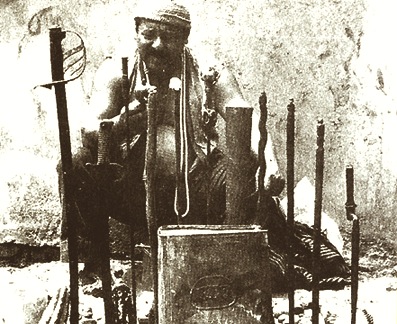
Don Eduardo contemplates his chontas and swords #
which help protect his mesa from the harmful influences of others.
This outline of Eduardo's curing ceremony is based upon explanations he gave Douglas Sharon of sessions which were conducted and tape recorded in the austral winter of 1970. These explanations were augmented by other sessions and explanations taped in the spring of 1971, the summer of 1974, and the summer of 1978. From comparisons of Eduardo's activities with the rituals of other curanderos, we know that songs and whistling accompanied by a rattle, raising the San Pedro brew and other substances including tabaco…, orally spraying perfumes and reciting Catholic prayers in conjunction with traditional chants are all typical features of northern Peruvian curanderismo.
CHARGING THE MESA
1. Apertura de la cuenta (opening of the account). Eduardo sets up the mesa in a special order: first the Campo Justiciero artifacts; second the Centro Medio artifacts; third, the Campo Ganadero artifacts; and last, the staffs from right to left. Then, while invoking the forces of nature along with the four winds and four roads, he fills his mouth with sugar and Tabu™, and sprays the mixture three times over the mesa to purify it. After a second invocation, this same operation is repeated three times with sugar and agua florida. This is followed by another invocation and three more blasts of spray composed of sugar and agua cananga. Finally, sugar and sweet-lime juice are sprayed three times over the mesa. (Usually the total number of blasts is twelve.)
2. Oraciones (prayers) to the Campo Justiciero addressing God, the Virgin Mary, and the saints of the Roman Catholic faith. These prayers, mostly in Spanish with a little Latin and some Quechua, include the Hail Mary and the Our Father.
3. Llamada (call) to the sacred mountains and lagoons, the ancient shrines, and to curanderos, alive and dead, so that they will attend the session in spirit. This call is made by a tarjo, or chant, which starts with Eduardo rhythmically shaking the chungana, or rattle.
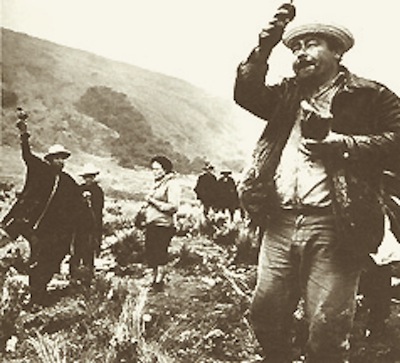
4. The raising (levantada) of the mesa in general con las siete mil cuentas (with the seven thousand accounts). After another series of prayers, mainly from within the realm of Roman Catholicism, Eduardo raises the mesa with tabaco (imbibes tabaco through his nostrils). This is done seven times (for the seven “justices” of Christ -- seven important events in the life of Christ); each time, a whole shell is emptied and a short invocation is given. During this raising, Eduardo holds the Dagger of Saint Michael, the crucifix, and the rattle above his head. When he is finished, each assistant also imbibes one shellful of the same liquid. Not one drop of tabaco must be spilled, for if it is, the person doing the raising must start over again. This operation activates the crucifix, the axis of the mesa.
5. Call to all the encantos justicieros (good charms). Eduardo sings a tarjo, addressed to personages of the Christian tradition -- Jesus, the Virgin Mary, the apostles, saints, and angels -- and to the miraculous events in their lives.
6. Raising con las doce mil cuentas (with the twelve thousand accounts). Eduardo invokes the twelve thousand accounts while either abstaining from or raising tabaco. He then pours one shell of tabaco for each assistant to raise. This operation activates the forces of good within the Campo Justiciero.
7. Tarjo relating to the birth, life, death, and resurrection of Jesus, and the beginning of the early Church. It is intended to invoke His presence in spirit.
8. Call and petition to God. Eduardo imitates the consecration of the mass by raising a mixture of Holy Water and Tabu™ above his head and then drinking it. This act is followed by his putting Tabu™ in his mouth and then spraying the crucifix three times. This ends the liturgical acts between the curandero and God.
9. Raising con las veinticinco y doscientos cinquenta mil cuentas justicieras y ganaderas (with the twenty-five and two hundred fifty thousand accounts related to white and black magic). the number 25 in curandero symbology is composed of two 12s, each symbolizing the eleven faithful disciples plus Paul, as well as a 1 symbolizing Judas. Twenty-five is then multiplied by ten thousand to increase its power. In this way, Eduardo indirectly invokes the forces of evil associated with 13 to help his work (12 + 1 = 13 + 12 = 25), for these are the forces responsible for witchcraft, and therefore most capable of revealing its causes. However, the forces of evil are carefully counterbalanced by the forces of good -- the two 12s -- in this operation, since 12 + 12 + 1 also equals 25. This raising thus activates the balanced forces of the Centro Medio and, in the process, the evil forces of the Campo Ganadero. A brujo would raise the mesa with las treinta y trescientos mil cuentas (symbolizing the thirty pieces of silver Judas received for betraying Christ), which would weight the invocation toward the forces of evil. In this phase of the curing session, the two assistants each imbibe one shell of tabaco through the nose, but Eduardo abstains.
10. Tarjo addressed to all the forces of nature and to the ancients. In this tarjo Eduardo invokes the now activated forces of both campos, justiciero and ganadero -- the mountains, lagoons, ancient shrines, streams, gardens of magical plants, and curanderos, alive and dead. At its end or in a separate tarjo, he then sings all his staffs to life, starting with the Saber of Saint Michael in the Campo Justiciero and ending with Satan's Bayonet in the Campo Ganadero.
11. Raising of the San Pedro remedy. Eduardo pours tabaco into a shell, makes a cross with it over the mesa, and hands it to one of his assistants, who then bends down beside the can of San Pedro brew. The assistant then lifts up his shell alongside the can, makes a cross with it over the remedy, stands, and imbibes the tabaco through his nose. This is repeated twice more, once with agua cananga by itself and once with Tabu™ by itself; then this same procedure is performed by the second assistant -- who is followed by everyone else present at the session except Eduardo (but only with tabaco; not the perfumes. If for some reason a patient cannot get the tabaco down his nostrils, he is allowed to swallow it.
12. Purification and presentation of the San Pedro remedy and the curandero to the mesa. One of the assistants brings a full cup of the remedy to Eduardo, who places it on the mesa in front of him. He then picks up the seguro (herb jar), the dagger, and the cup of San Pedro, and he stands up. After serving themselves with one shell of tabaco each, his assistants now take positions on both sides of him, and while he performs a tarjo in his own name -- holding the seguro, rattle, dagger, and cup of San Pedro at the same time -- they simultaneously move their shells along his body from feet to waist, waist to neck, and neck to crown. Next, they imbibe the tabaco mixture, and when they have finished, Eduardo performs a limpia or cleansing of himself by rubbing the seguro all over his body from, head to toes. He then sits down, places everything back on the mesa, and orally sprays the seguro three times with agua florida, three times with Tabu™ and three times with agua cananga.
13. The previous step is followed by yet another raising in the name of the remedy, this time performed by Eduardo with one shell of tabaco. He then lifts the full cup of San Pedro from the mesa, drinks it in one draft, massages his head with the empty cup, and blows into the cup three times. Patients and guests are not now also required to raise the San Pedro brew with tabaco like Eduardo, but at this point they too must go through the same procedure of drinking the pure infusion, rubbing, and blowing. To end this phase of the ceremony, Eduardo now serves pure San Pedro to his assistants, first presenting their individual servings to the mesa and then making a special benediction in the name of each one. Both assistants follow the same procedure in drinking the remedy as did the patients: drinking, rubbing the head, and blowing.
14. Limpia (cleansing) of all present. Eduardo stands beyond the staffs of the mesa, making sure that one of his assistants occupies his seat at the mesa at all times, and has the patients and assistants come before him, one at a time. As each person comes forth, he rubs him or her from head to foot with the chungana, and he then blows on his rattle with a sharp expulsion of air (sopla). When he has done this for everyone else, he performs the procedure on himself. It is now midnight, and this ends the charging of the mesa.
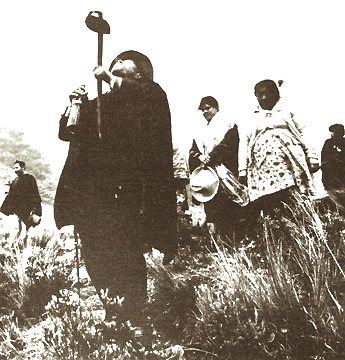
Eduardo Calderón revered the sacred lagoons of Las Huaringas
in the northern Andes. Here he calls the spirit of the laguna to
bring healing and good luck to pilgrims who have come from afar. #
THE CURING ACTS (Discharging the mesa)
1. Purificación (purification) of the mesa. Eduardo orally sprays his mesa with the three perfumes and sugar as he did in the opening ceremony.
2. Rastreo (tracking or tracing). The patient stands beyond the staffs at the front of the mesa facing Eduardo, who now sings a tarjo in the name of the patient. All present then concentrate on the staffs to see which one vibrates. Once agreement is reached, this staff is given to the patient to hold in his or her left hand over the chest. Everyone now concentrates on the patient and staff, while Eduardo chants a tarjo in the name of the staff. This tarjo includes all the accounts associated with the staff, and it is intended to activate the patient's spirit, reveal the illness, and invoke the spirits, if any, that are antagonizing the patient. It is followed by a reflective silence that may last five or ten minutes.
3. Cuenta (account). As the persons and events of the patient's life begin to be “ seen” by Eduardo, he relates them, interspersing his narration with questions and comments. During this phase, other patients or guests may share some of Eduardo's visions. It is now that Eduardo “sees” the causes of daño (witchcraft), enredo (love magic), or suerte (bad luck), if these are the ailments bothering the patient. In serious cases, this is a critical phase in which many effects of the ailment may manifest themselves in the patient.
4. Desmarco or descuenta (removal or discount). Eduardo sings a final song relating to the accounts of the staff.
5. Raising the patient. During the last song Eduardo's two assistants have taken positions on either side of the patient, and now they “raise” him or her from feet to waist, waist to neck, and neck to the top of the head with one shellful of whatever substance is indicated for the ailment. This procedure is to help remove the cause of the patient's illness by “centering” him or her.
6. Raising the staff. The patient holds the staff over his or her head by its tip and nasally imbibes whatever substance is specified by Eduardo. In severe cases of daño, the patient has great difficulty getting the substance down and often vomits (which is considered necessary in the treatment of daño induced by food or drink). This can be another critical period in the treatment of serious cases. If the patient cannot get the substance down, one of the assistants or Eduardo himself may have to do so in his or her name, after which Eduardo may still have to perform a symbolic sword battle and the seven somersaults (siete mortales) necessary to combat witchcraft.
7. Cleansing of the patient. Once the patient has raised the staff, an assistant takes it from him or her and rubs it all over the patient's body.
8. Sopla (blowing) and chicotea (violent shake) of the staff. An assistant or Eduardo now sprays the patient's staff three times with whatever liquid is indicated by the account. He then slices the air with the staff in whatever compass direction or directions are indicated, and he returns it to its proper position at the front of the mesa.
9. Salto sobre el fuego (leap over the fire). After the curing acts are performed for all present, the victims of the witchcraft must then leap four times so that their movements form a cross over a small bonfire of straw lit by Eduardo's assistants. After the jumps, each must then stamp out the fire. Then, as each individual patient steps backwards, an assistant cuts the ground between his or her feet with one of the mesa swords. This appears to be a symbolic act indicating “mastery over fire” or “magical heat,” a shamanistic attribute that is passed on to the patient in order to purge and purify him or her by exorcising evil spirits. In some cases the salto may be performed before the rastreo (step 2). 10. Florecimiento (“flowering”). For patients whose cures are nearly completed, Eduardo often conducts a final centering ritual. This consists of Eduardo placing the patient within a circle of white corn meal drawn on the ground, his spraying holy water around the patient at the four cardinal points while cutting the spray with a sword, and then his cutting a final spray in the form of a spiral in front of the patient. After these acts, Eduardo may give the patient some advice or instructions. 11. Cierre de la cuenta (closing of the account). This is the same as the opening ceremony. It is performed after Eduardo has repeated steps 1 through 8 for all present except himself, as well as conducted the florecimiento and the fire ceremony reserved for victims of witchcraft (steps 9 and 10). 12. Refresco (purification, or “refreshment”) of participants and locale. The two assistant orally spray a mixture of holy water, white cornmeal, white flowers, white sugar, sweet-lime juice, and powdered lime in the faces, on the necks (front and back), and over the hands (front and back) of everyone, including Eduardo and each other. While they are “refreshing” the patients. Eduardo gathers up his artifacts in the same order as he put them down at the beginning of the session -- Justiciero, Medio, Ganadero, and staffs from right to left. All of his artifacts must be put away before sunrise to prevent sunlight from striking them, and any leftover San Pedro is buried for the same reason. Once he has packed everything up, he uses his dagger to cut a cross three times in the earth where the mesa was laid, and he then sprinkles the refresco mixture used by his assistants three times along the cuts in the ground and once in each of the four corners of the mesa area, which must not be touched by anyone until noon of the day in progress. All participants are then required to abstain from condiments (especially salt, hot peppers, onions, and garlic), pork, beans, or any plant that grows on a vine or has twisting roots until noon of the day in progress. *From Eduardo El Curandero: The Words of a Peruvian Healer, Revised Edition by Eduardo Calderón, Richard Cowan, Douglas Sharon, and F. Kay Sharon, published by North Atlantic Books, copyright © 1999 by Eduardo Calderón, Richard Cowan, Douglas Sharon, and F. Kay Sharon. Reprinted by permission of publisher.
# Photos and captions from Choque Chinchay Shamanic Journeys.