llacssactam
(n) Unpleasant visual hallucinations. DYEDYE · Source not listed on the original Text Sources page.
50 entries · 1 editorial note
(n) Unpleasant visual hallucinations. DYEDYE · Source not listed on the original Text Sources page.
One of the legendary lineage ayllus of Cajatambo. They conquered the Guari ayllu and shared ritual beliefs. MANMAN · Mythology of the American Nations, Jones and Molyneaux The Wari people (who lived in coastal Peru), venerators of earthly deities, are associated with fertility and the generative forces of the female earth. People who were relative newcomers were known as Llacuaz, and believed that their ancestor was the Lightning deity in the sky [Koa] who had come from Lake Titicaca, a place that symbolized the end of the world. Thus, the Llacuaz were considered outsiders. This gender distinction continued into the colonial era, with foreigners or outsiders adopting male Christian saints as their ancestors while the original inhabitants venerated female saints. HIMHIM · Handbook of Inca Mythology, Steele [In coastal Peru the word now means] outsider, invader; or a class of deities associated with the upper world. GOLGOL · The Gift of Life: Female Spirituality and Healing in Northern Peru, Glass-Coffin.
(n) A title given to representatives from the highlands and lowlands, who perform roles at the mountain rituals. MOCMOC · Mountain of the Condor: Metaphor and Ritual in an Andean Ayllu, Bastien
(v) To feel bad. (adj) Melancholy. (n) Depression. PSLPSL · www.geocities.com/phillott/Bolivia/Dictionary02.htm — Bolivian Quechua
(v) To sense, to feel. QPQP · Quechua Phrasebook, Coronel-Molina
(n) (1) A domesticated guanaco. One of the species of camelids that are domesticated in the Andes, the alpaca and vicuña being the others, although some consider the alpaca and llama to be the same species. Of these, the llama was the most prized by the Inca for their wool, used to make the luxury textiles needed for religious rites; they also played a role in the complex procedure of offering gifts to the elite of Cusco. The Inca himself consumed on a large scale exquisite textiles made of their wool. He seldom wore a garment more than once and would change clothing several times a day; his litter was also covered with the finest material. Many of the special garments reserved for the emperor and his family were woven in the temples by the akllas. AKPAKP · The Ancient Kingdoms of Peru, Davies (2) It also served in Inca religion as a major sacrificial offering, white llamas being the preferred victims of the sun. Each morning in Cusco one llama was sacrificed by cutting its throat, while keeping its head turned towards the sun, to which it was being offered. The animal was then burned in a special brazier. AKPAKP · The Ancient Kingdoms of Peru, Davies During the Inti Raymi, there was a compulsory participation of priests in the ceremony of augury by sacrificing a llama. The Wirapiricuq, the one that took the guts of the animal; the one called Kallpa Rikuq, shepherd of the sacrificial llamas; the Turpuntay, or priest in charge of the cutting with the sacred knife called tumi; and the Willaq Umu in charge of the forecast or prediction observing the viscera of the llama, the one who told the Inca the good or bad news. UNKUNK · The original author's marker for an unknown / unattributed source.(See, raymiyahuar.) (3) The llama is the symbol of love and service. In a despacho, the llama fetus is charged with carrying the intentions or message into another reality. IGMPIGMP · Andean Awakening: An Inca Guide to Mystical Peru, Delgado (4) One of the yana phuyu. Its bright eye is the stars Alpha and Beta Centauri (see, image 1 at Southern Cross). Also known as the Flying Llama because in the rainy season she flies to the sea to drink the water and then returns and releases the water to fall to the earth as rain to nourish the crops. IGMPIGMP · Andean Awakening: An Inca Guide to Mystical Peru, Delgado
(n) From llamar, to call. The act of calling in, invoking, or asking for visitation. PSPMPSPM · Peruvian Shamanism: The Pachakúti Mesa, Magee
pica-pica: (n) Literally, eye of llama. Mucuna elliptica. The seeds are believed to be antidotal to the stings of small insects. They are taken in the form of a powder in two doses, and the powder is dusted over the bites of the toxic animal. REPCREPC · Ruiz as an Ethnopharmacologist in Peru and Chile, Schultes [taxonomy accuracy questionable] Seeds ground into powder and applied to insect and reptile bites, may be drunk as antidote. EPAEPA · Preliminary Ethnobotany of the Peruvian Amazon, Bodley In some places the name is picapica, on account of the little bristles which, entering the skin, cause pain or inconvenience; several persons assured us that these taken with chocolate-milk or honey and water are an excellent anthelmintic. FOPFOP · Flora of Peru, MacBride
(n) The eyes of the llama; a constellation consisting of two stars in a llama-shaped dark-space constellation directly next to the Hatun Chakana (the Southern Cross, the entry point of consciousness into this world), reminding us that we came into the world to be of loving service and that we will leave this world to be of service to Creator. ANON1ANON1 · anonymous donor 1 (see footnote on the original Text Sources page for explanation) Two first-magnitude stars, called alpha Centauri and Hadar in Western astronomy. At the time of the Conquest, the natives of Huarochiri described this magnificent object to chronicler Avila: They say that Yacana, as we call it, is like the shadow of a llama, a double of this animal which walks down the center of the sky, as it were a darkness in the sky. That’s how we men see it coming, yes, dark. They say this Yacana (when it reaches the earth) walks beneath the rivers. It is very large indeed, blacker than the night sky , it advances, with its long neck and two eyes, it comes. SIMASIMA · The Secret of the Incas: Myth, Astronomy, and the War Against Time, Astronomy, and the War Against Time,* Sullivan See, also, Yana Phuyu.
(v) To feel (by sense of touch). QPQP · Quechua Phrasebook, Coronel-Molina
(adj) Soft hearted, humble. PSLPSL · www.geocities.com/phillott/Bolivia/Dictionary02.htm — Bolivian Quechua
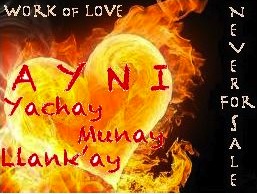
, llankay, llancay, llancai, llamk’ay, llamkay: (n) (1) Work, labor, industriousness. RSRS · runasimi.deIt is power of action and labor. One of the Three Inca Laws. It is the law of service, work, and creative expression of your individual gifts. IGMPIGMP · Andean Awakening: An Inca Guide to Mystical Peru, Delgado Meeting one’s survival needs in order to continue with the spiritual pursuits of life. PSPMPSPM · Peruvian Shamanism: The Pachakúti Mesa, Magee (2) The power of the body, the power of physical work. RSRS · runasimi.de The power of sacred industriousness, of our capacity to act and work in a sacred manner in physical reality; mastery of/in the physical realm. ANON1ANON1 · anonymous donor 1 (see footnote on the original Text Sources page for explanation) (3) The lower energy center located at the navel, comprised of chakras one, two and three. JLHJLH · Jose Luis Herrera, various lectures The lowest energy center, the qosqo. IGMPIGMP · Andean Awakening: An Inca Guide to Mystical Peru, Delgado (See, munay, yachay.)
(n) Firewood. PSLPSL · www.geocities.com/phillott/Bolivia/Dictionary02.htm — Bolivian Quechua
(n) Everyone. QPQP · Quechua Phrasebook, Coronel-Molina
(n) Village, town, city; sometimes can mean “fatherland” or birthplace. ANON1ANON1 · anonymous donor 1 (see footnote on the original Text Sources page for explanation)
(n) This is a medium-sized tutelary mountain spirit related with the second level of the Andean spiritual path. QNOQNO · www.quechuanetwork.org The sacred mountains of many villages. Llaqta means city or town, thus a llaqta apu influences a geographical area that encompasses a group of villages. Pachatusan and Huanacauri are examples. PSPMPSPM · Peruvian Shamanism: The Pachakúti Mesa, Magee A medium sized tutelary Apu; a city Apu, or the Apu protector of a specific town, city, or small region.This designation is not meant to limit an Apu’s perceived power, rather, to specify one’s relationship with the Apu. ANON1ANON1 · anonymous donor 1 (see footnote on the original Text Sources page for explanation) See, ayllu apu and suyu apu. (See, apu.)
(n) A village official. ACEACE · Source not listed on the original Text Sources page.
(adj) Heavy. (n) Weight. QPQP · Quechua Phrasebook, Coronel-Molina
(n) Headband. A scarlet headband was the Inca symbol of royalty. (See, second image at Manco Capac.) IAWSIAWS · Mythology, Illustrated Anthology of World Myth & Storytelling Crown; wreath, corona. RSRS · runasimi.de (See, accorasi.)
See, yahuar.
(n) (1) Cloth; equivalent of the Spanish manta; a cloth used to bundle and carry medicine pieces, a healer’s mesa, and/or despachos. ANON1ANON1 · anonymous donor 1. Click * for explanation. A small rectangular cloth woven from alpaca and used to wrap the paq’o’s collection of power objects (the mesa). QNOQNO · www.quechuanetwork.org (2) A rectangular, handwoven shoulder cloth. It is worn by Quechua women of the Andes. Traditionally it is fastened at the front using a decorated pin. WIKIWIKI · en.wikipedia.org (no www)
(n) Color. QPQP · Quechua Phrasebook, Coronel-Molina
(adj) Clean; totally, completely; all. PSLPSL · www.geocities.com/phillott/Bolivia/Dictionary02.htm — Bolivian Quechua [Possibly from Sp. limpia.]
(v) To make clean, to sanctify. PSLPSL · www.geocities.com/phillott/Bolivia/Dictionary02.htm — Bolivian Quechua
(v) To become clean. PSLPSL · www.geocities.com/phillott/Bolivia/Dictionary02.htm — Bolivian Quechua
(v) To shine. PSLPSL · www.geocities.com/phillott/Bolivia/Dictionary02.htm — Bolivian Quechua
(n) (1) Compressed ash of certain plants chewed with coca to release alkaloids. RORROR · Rituals of Respect, BolinAsh of quinoa and other plants that is then mixed with coca leaves and chewed. IGMPIGMP · Andean Awakening: An Inca Guide to Mystical Peru, Delgado A condiment for coca; substance placed in the mouth when chewing coca leaves; it causes the release of the alkaloids; made from vegetable ash and lime. RSRS · runasimi.de Often called lime ash; a mixture of seeds, ashes from fires of specific plants, and sometimes even crushed shells; when mixed with coca, creates a chemical reaction that allows for greater absorption of the alkaloids in the coca. ANON1ANON1 · anonymous donor 1 (see footnote on the original Text Sources page for explanation) (2) a lime pouch to use with coca to release the inebriating alkaloids. EPPEPP · The Encyclopedia of Psychoactive Plants: Ethnopharmacology and Its Applications, Rätsch
(n) Literally, big, brilliant woman. Great fairies that defend the Aceropunta from outer space. AYVAYV · Ayahuasca Visions: The Religious Iconography of a Peruvian Shaman, Luna
(n) (See, llipht’a.)
(v) To glance. RSRS · runasimi.de (n) The art of seeing or mapping, of putting out luminous markers (re. mapping your seeing states; see, Appendix I.) AVOAVO · my notes from Alberto Villoldo, various writings and lectures
(adv) Left (opp. of right). RSRS · runasimi.de(adj) Relatively sinister or powerfully lunar. PSPMPSPM · Peruvian Shamanism: The Pachakúti Mesa, Magee(n) The left, or feminine side, associated with the magical, eros (vs. mystical). Both sides must be integrated in order to push the kawsay. KOAKKOAK · Keepers of the Ancient Knowledge, WilcoxLeft-hand side of the path. Relates to the magical knowledge or application of spiritual knowledge in the physical world. Healing, magic, therapy, remedies, all are considered gifts of the left-hand side of the path. The complement is paña, or right–hand knowledge. QNOQNO · www.quechuanetwork.orgBy balancing your own lloque and paña energies, and following the pathway of your power, you can go through any obstacle, even physical walls. IGMPIGMP · Andean Awakening: An Inca Guide to Mystical Peru, Delgado In relation to the curandero mesa, the left side is not evil or bad, it simply contains the energy that is used to neutralize acts of daño, or negative events that have already taken place in the life of the person seeking healing. The left field of the mesa is not only used to discern the source of the problem, it can be used in defense to counteract the problem or to return it to its place of origin. PSPMPSPM · Peruvian Shamanism: The Pachakúti Mesa, Magee The left-hand side of the shamanic path, sometimes understood to be sinister or overwhelmingly lunar in nature; this path is not perceived as evil or negative, but contains energy or medicine used to neutralize or counteract evil presence, witchcraft, and illness of harm; the lloq’e also relates to past events that need to be healed in the present and relates to magical knowledge and practices, or application and manifestation of spiritual knowledge in the physical world; the path of the magician or sorcerer; various forms of healing, magic, therapy, and remedies are all considered gifts of this left-hand side of the path; the complement is paña, or right–hand knowledge. ANON1ANON1 · anonymous donor 1 (see footnote on the original Text Sources page for explanation) (See, paña and chawpi.)
Described as “getting rid of bad witchcraft” by the indigenous people. In the west, Américo [Yabar] tells us, it is equivalent to getting rid of our neuroses and depression. The magic of lloq’e nacuy uses threads to represent filaments of light. The healer’s work is to connect a person’s filaments with the light of the stars (hanaqpacha). As filaments of a person’s heavy energy — pain, sadness, depression, envy — are cut away, the filaments of her etheric body and those of Pachamama rise up and mingle with the filaments of the stars, creating feelings of being cleansed, energized, peaceful, filled, and rejuvenated. MBEMBE · home.earthlink.net/~megbeeler
(n) Pigment obtained from red earth used to mark the fur of animals in a ceremony. RORROR · Rituals of Respect, Bolin
Come out! Release! Escape! RSRS · runasimi.de JLHJLH · Jose Luis Herrera, various lectures Used in the imperative form, becomes a powerful, commanding mantra to expel hucha and the influence of lower-vibrational entities; can also be used as a prayerful command for a spirit presence to come out and be seen, such as in the classic Cusco hymn Inti Raymi which states “Lloqsiy, Intillay” (come out, dear Inti). ANON1ANON1 · anonymous donor 1 (see footnote on the original Text Sources page for explanation) (v) To depart, go away. QPQP · Quechua Phrasebook, Coronel-Molina To rise; to come out. RSRS · runasimi.de
, llocke, lloq’e**.**: (n) Kageneckia lanceolata. The bark and leaves are bitter and are employed in infusion for treating fevers. REPCREPC · Ruiz as an Ethnopharmacologist in Peru and Chile, Schultes [taxonomy accuracy questionable] This plant also has antimalarial qualities. WIKIWIKI · en.wikipedia.org (no www)
(n) A cure.
(n) The name of the legendary third Inca ruler in Cusco, probably sometime in the 12th Century. MANMAN · Mythology of the American Nations, Jones and Molyneaux “The glorified lefthander.” WIKIWIKI · en.wikipedia.org (no www) He, was not warlike and added no lands to the Inca domain. WBCWBC · www.britannica.com
**He suffered from some sort of endocrine disturbance which prevented him from siring the heir. “He never cared for women and was totally beardless until he was quite old,” according to the chronicles, “and he must have considered his hairlessness as something unbecoming, since he ordered that all noblemen should have their beards plucked out so that they were as hairless as he….”
Lloque Yupanqui was very depressed because there was no heir to the throne and Inti appeared in the form of a person and consoled him by saying: “Do not
be sad, Lloque Yupanqui, you will sire a great lord” and continued saying that
he could be certain that he would have a male heir, even though he was too old and had no sons and never expected to have one. Upon hearing this, his
relatives decided to provide him with a wife. His brother, Manco Sacapa,
aware of his condition, searched for a woman** *adaptable to the
circumstances***. Mama Cava gave birth only three months after being
sired by Lloque Yupanqui. His name was Mayta Capac.** DYEDYE · Source not listed on the original Text Sources page.
(v) Open the ears (to listen). ASDASD · Vocabulario de la Lengua Aymara
(n) An apu in Argentina where three children, qhapaq hucha sacrifices, were discovered and excavated, along with many artifacts. The site is estimated to be 500 years old. WP2WP2 · www.washingtonpost.com/wp-srv/national/daily/april99/mummies07.htm The three Inca children found mummified consumed increasing amounts of coca and corn beer for up to a year before they were sacrificed. Sedation by the drugs and alcohol combined with the frigid, high-altitude setting may explain how the children were killed. There is no evidence for direct violence. The coca and alcohol consumption rose about six months before death and then skyrocketed in the final weeks, especially for the eldest, a 13-year-old girl known as the “Ice Maiden” [image below]. She was probably heavily sedated by the point at which she succumbed to death. The finding is based on detailed analyses of hair taken from the more than 500-year-old mummified remains, which also include a four-year-old girl and a five-year-old boy. The boy and girl were perhaps the maiden’s attendants. The data corroborate earlier research showing the children ate more meat and corn in their final year. Taken together, the studies suggest the peasant children were selected for the ritual sacrifice and lived a high-status life until their death. NGEO8NGEO8 · news.nationalgeographic.com/news/2013/07/130729-inca-mummy-maiden-sacrifice-coca-alcohol-drug-mountain-andes-children/ (See, Ampato.)
(adj) Pure, innocent. QPQP · Quechua Phrasebook, Coronel-Molina
(adj) Wonderful QPQP · Quechua Phrasebook, Coronel-Molina
See, lloke. QPQP · Quechua Phrasebook, Coronel-Molina
See, lloqsi.
(n) A state of markedly blurred vision. DYEDYE · Source not listed on the original Text Sources page.